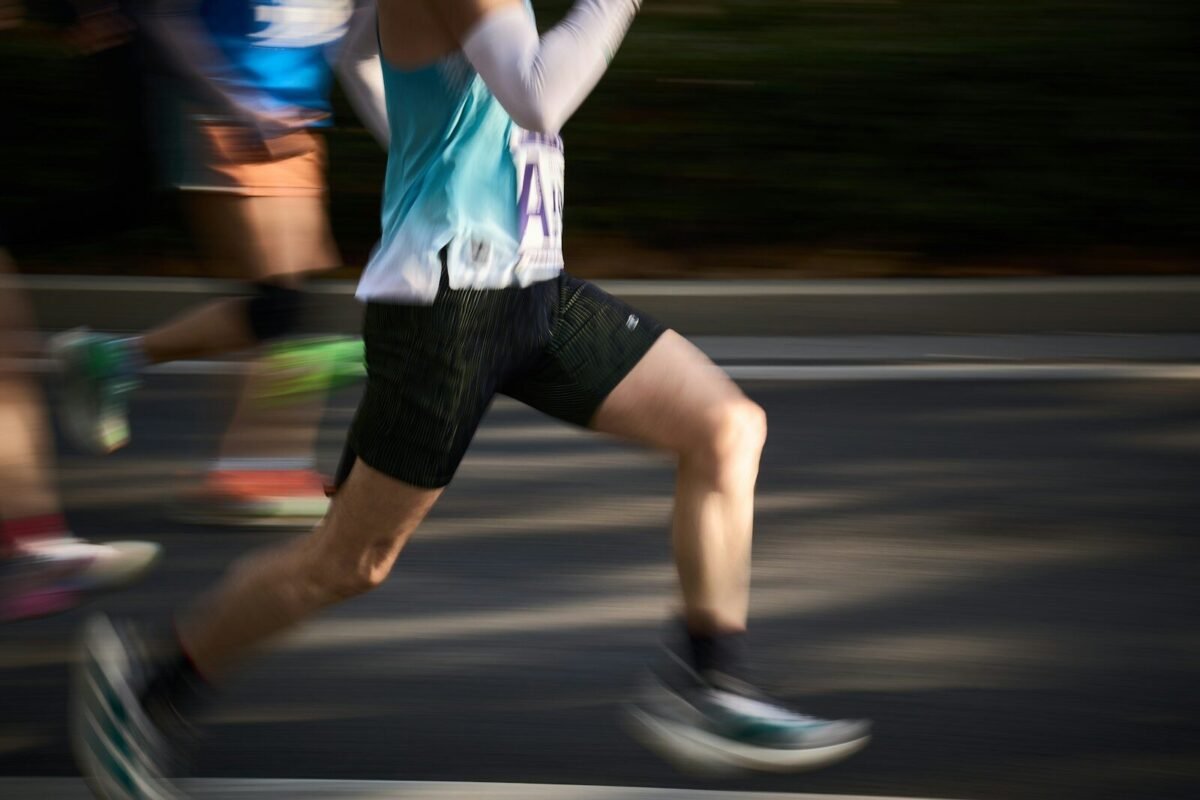
One of the easiest things to notice when watching runners is the length of their stride. Some runners seem to glide effortlessly with long, flowing steps, while others take quicker, shorter strides that carry them forward just as smoothly. It’s tempting to assume that the runner taking the biggest steps must also be the fastest.
The truth is more interesting.
Stride length changes naturally as your pace changes. It also reflects your height, flexibility, strength, running experience, and the terrain beneath your feet. Efficient runners don’t consciously chase longer strides. Instead, they allow stride length to develop naturally as a result of good posture, balanced cadence, and relaxed movement.
What Is Stride Length?
Stride length is the distance your body travels between one foot contacting the ground and that same foot contacting the ground again.
It works together with cadence to determine your running speed.
You can run faster by increasing your cadence, increasing your stride length, or adjusting both in a way that feels natural and efficient.
Neither measurement exists independently.
Every runner develops a relationship between cadence and stride that reflects their own body and running style.
Longer Isn’t Always Better
Many beginners make the mistake of deliberately reaching farther with each step.
At first, it feels as though they’re covering more ground and running more efficiently.
Often the opposite happens.
When the foot lands too far ahead of the body’s centre of mass, it creates a braking effect. Instead of smoothly carrying momentum forward, each step briefly slows the body before the next stride begins.
Running becomes less fluid and often requires more energy.
True stride length comes from effective push-off behind the body rather than reaching excessively in front of it.
Stride Length Changes Naturally
One reason there isn’t an ideal stride length is that it constantly changes.
During an easy run, your stride is usually shorter and more relaxed.
As your pace increases, your stride naturally becomes longer.
Running uphill often shortens your stride.
Running downhill may lengthen it slightly.
Fatigue during longer races can also influence the way your body moves.
These adjustments happen automatically because your body is continuously responding to the demands of the environment.
Efficient runners allow these changes to occur rather than trying to maintain exactly the same stride in every situation.
Stride Length and Cadence Work Together
Imagine trying to run faster by taking enormous steps while keeping the same cadence.
The movement would quickly become awkward and inefficient.
Now imagine taking extremely rapid steps without allowing your stride to lengthen naturally.
Again, running would feel forced.
Efficient running depends on both measurements working together.
As fitness improves, many runners notice that their cadence becomes more consistent while their stride length develops naturally through improved strength, coordination, and confidence.
The body often solves this problem more effectively than conscious effort ever could.
What Causes Overstriding?
Overstriding occurs when the foot lands too far in front of the body.
This often happens when runners try to increase speed by reaching forward instead of generating more power behind them.
Overstriding can increase braking forces and place additional stress on parts of the lower body.
It isn’t defined simply by having a long stride.
A tall runner may naturally have a longer stride than someone shorter without overstriding at all.
The key is where the foot lands relative to the body’s centre of mass.
Can You Improve Your Stride Length?
Yes, but not by forcing it.
Improving overall running fitness often produces the biggest changes.
As strength develops, posture improves, and cadence becomes more efficient, stride length usually follows.
Exercises that improve hip mobility, lower body strength, and running coordination can also support smoother movement.
Trying to consciously lengthen every step during a run rarely produces lasting improvements.
Natural movement is almost always more sustainable than exaggerated movement.
Focus on Smoothness, Not Size
A useful way to think about stride length is to stop thinking about length altogether.
Instead, ask yourself different questions.
Does my running feel relaxed?
Am I maintaining good posture?
Is my breathing comfortable?
Do my steps feel smooth and balanced?
Answering these questions often leads to better movement than concentrating on how far each foot travels.
Running well is more about rhythm than reaching.
Every Runner Has Their Own Stride
There is no universal stride length that every runner should copy.
Elite runners display remarkable variety in the way they move because their bodies, training histories, and race demands all differ.
The same is true for recreational runners.
Your most efficient stride is the one that allows you to move comfortably, maintain rhythm, and conserve energy over the distance you’re running.
As your fitness improves, your stride will continue to evolve.
It may become slightly longer.
It may become more consistent.
More importantly, it will become more economical.
The goal isn’t to chase a bigger stride.
It’s to develop a stride that works naturally with your body, allowing every step to carry you forward with confidence rather than unnecessary effort. When cadence, posture, and stride length begin working together, running stops feeling like individual movements and starts feeling like one smooth, continuous motion.