Watch someone carrying a heavy shopping bag in one hand while trying to jog across a car park. Their stride immediately changes. Their body twists, balance becomes uneven, and every step looks less efficient. The legs haven’t forgotten how to run. They’re simply responding to what the upper body is doing.
This simple observation reveals an important truth about running form. Your arms are not passengers. They are active participants in every stride. While they don’t propel you forward in the same way your legs do, they help maintain rhythm, balance, and coordination. When your arms move naturally, your entire body often follows.
Why Do Your Arms Matter?
Running is a whole-body movement.
As one leg moves forward, the opposite arm naturally swings forward as well. This coordinated pattern helps balance the rotational forces created by your legs, allowing your body to move smoothly instead of twisting from side to side.
Without this natural arm movement, running would feel awkward and inefficient.
The faster you run, the more noticeable this coordination becomes. During a sprint, powerful arm action helps maintain rhythm and balance. During an easy run, the movement is smaller but still plays an important role in keeping your stride relaxed.
Relaxation Is More Important Than Power
Many runners assume they should actively drive their arms to create more speed.
For most recreational runners, that’s unnecessary.
Your arm swing should feel relaxed rather than forceful. The movement supports your running instead of dominating it.
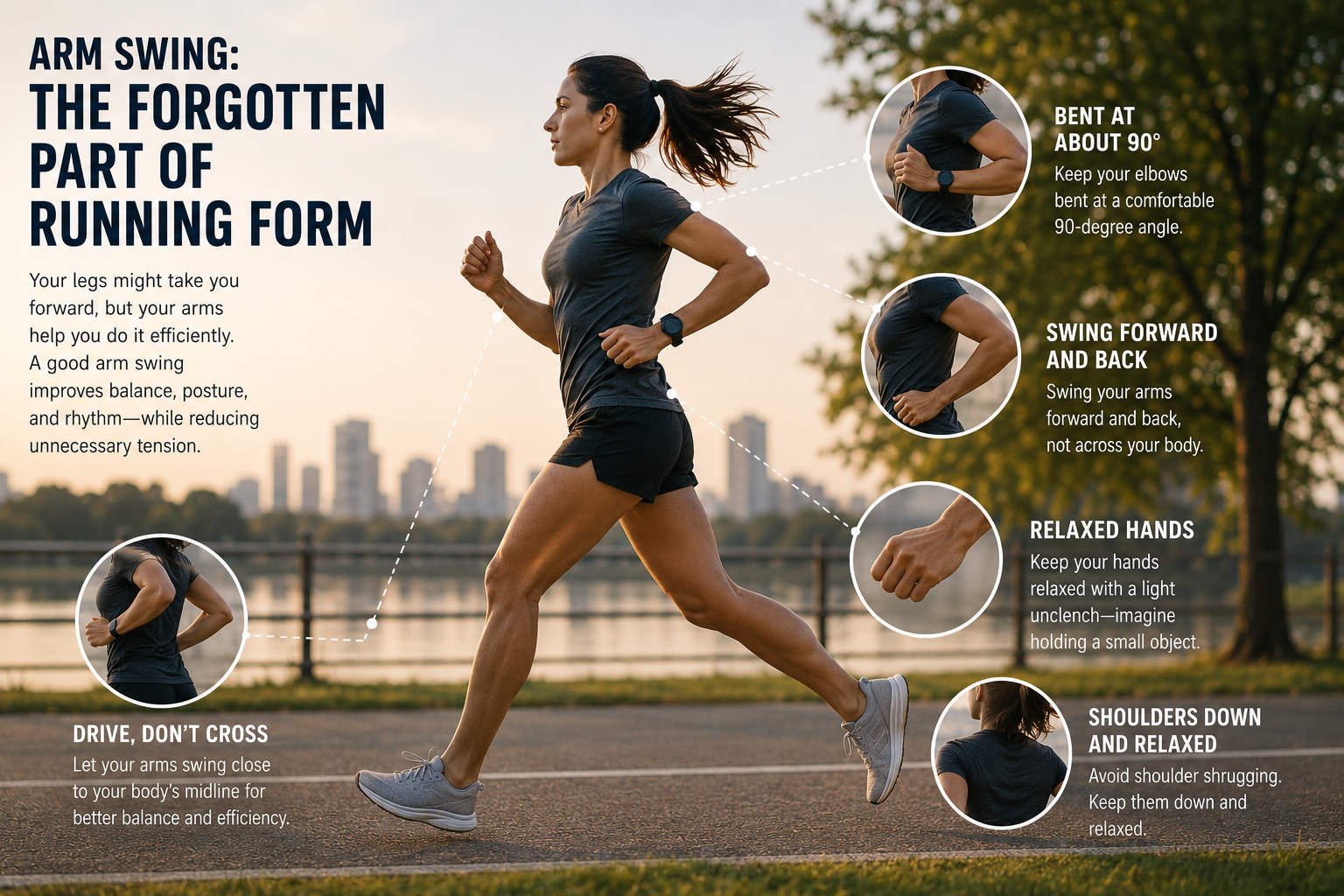
When the shoulders remain loose and the elbows swing naturally beside your body, your upper body uses less energy and allows your legs to move more freely.
Running efficiently often feels surprisingly calm.
Keep Your Shoulders Loose
Fatigue has a habit of creeping into the shoulders before runners even notice.
As effort increases, shoulders gradually rise towards the ears, creating tension that spreads into the neck, arms, and upper back.
This tension doesn’t make you faster.
It simply wastes energy.
During longer runs, take a few moments every kilometre or so to check your shoulders.
If they feel tight, gently shake out your arms or consciously allow your shoulders to relax.
Small reminders often make a noticeable difference over the course of a run.
What Should Your Arms Look Like?
There isn’t a perfect angle or exact movement that every runner should copy.
Instead, think about a few simple principles.
Allow your elbows to remain comfortably bent.
Let your hands stay relaxed rather than tightly clenched.
Swing your arms naturally forwards and backwards beside your body.
Avoid crossing dramatically in front of your chest, as this can encourage unnecessary rotation through the torso.
The movement should feel easy enough that you barely notice it.
The Hands Often Reveal Hidden Tension
A quick glance at your hands can tell you a surprising amount about your running.
Some runners tightly clench their fists, particularly during harder efforts.
Others straighten every finger as if reaching for something ahead.
Neither extreme is necessary.
Imagine gently holding a crisp leaf between your thumb and finger.
Firm enough that it won’t blow away.
Gentle enough that you won’t damage it.
This simple image encourages relaxed hands, which often helps relax the entire upper body.
Does Arm Swing Affect Speed?
Yes, but probably not in the way many runners imagine.
Efficient arm movement helps maintain rhythm, particularly as pace increases.
That’s why you’ll often notice more pronounced arm action during faster intervals or sprint finishes.
Trying to create speed solely through bigger arm movements rarely works.
Instead, allow the arms to respond naturally as your running speed changes.
They’ll usually find the rhythm your body needs.
Common Arm Swing Mistakes
One of the most common mistakes is carrying unnecessary tension.
Another is allowing the arms to swing widely across the body, creating excessive rotation through the torso.
Some runners also become so focused on arm technique that every movement feels rehearsed.
Running should never feel robotic.
The goal isn’t perfect arm mechanics.
The goal is relaxed coordination.
When your upper body feels comfortable, efficient movement often follows naturally.
Let Rhythm Lead the Movement
One of the easiest ways to improve arm swing is to stop thinking about your arms altogether.
Instead, pay attention to rhythm.
As your cadence settles into a comfortable pattern, your arms often begin matching that rhythm automatically.
This natural coordination is one reason experienced runners appear so smooth.
Their movements are not carefully choreographed.
They’re simply well practised.
The Body Moves as One
Running form is sometimes discussed as though every body part works independently.
Improve your foot strike.
Adjust your cadence.
Fix your posture.
Correct your arm swing.
In reality, the body doesn’t work like a collection of separate pieces.
Every movement influences another.
Relaxed shoulders support comfortable breathing.
Natural arm swing improves balance.
Balanced posture allows smoother leg movement.
Good running form emerges when all these elements work together.
The next time you head out for an easy run, don’t spend every kilometre analysing your arms.
Instead, notice how your whole body feels.
When your upper body is relaxed, your rhythm steady, and your movement free from unnecessary tension, your arms quietly do exactly what they’ve always been designed to do. They help every stride feel just a little smoother, making the entire run feel easier without demanding attention for themselves.
Leave a Reply