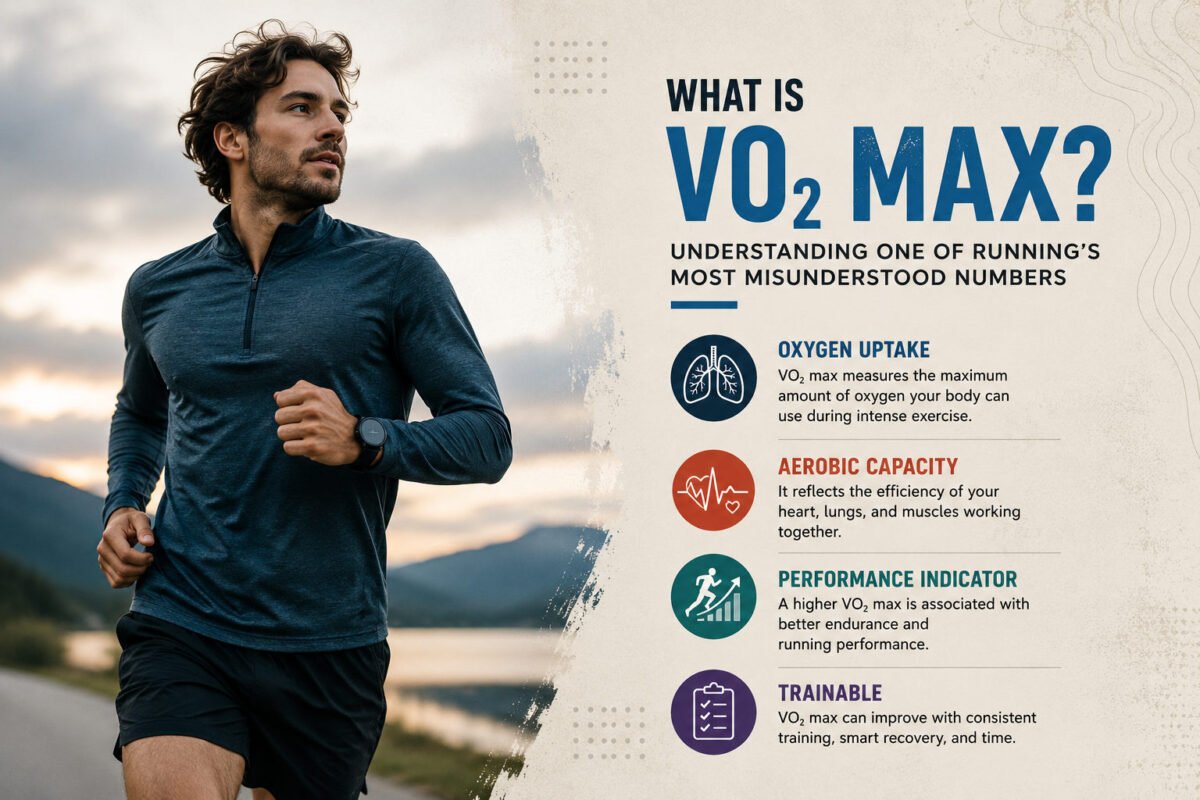
Spend enough time around runners and you’ll eventually hear someone mention their VO₂ max. Watches display it. Training apps estimate it. Elite athletes are often praised for having exceptionally high values. It’s easy to believe this single number determines how good a runner you can become.
The reality is far more interesting.
VO₂ max is an important measurement, but it tells only part of the story. Some runners with extraordinary VO₂ max values never reach their full potential, while others achieve remarkable performances with numbers that appear less impressive. Running success depends on many factors working together, and VO₂ max is only one of them.
What Does VO₂ Max Mean?
VO₂ max stands for maximum oxygen uptake.
In simple terms, it describes the greatest amount of oxygen your body can use during intense exercise.
When you run, your muscles require oxygen to produce energy. The harder you run, the more oxygen they need.
Eventually, you reach a point where your body cannot deliver or use oxygen any faster.
That point represents your VO₂ max.
Think of it as the maximum capacity of your aerobic engine.
It doesn’t describe how fast you normally run.
It describes the upper limit of your body’s ability to use oxygen during demanding exercise.
Why Oxygen Matters
Every step you take requires energy.
During most runs, that energy is produced by combining oxygen with carbohydrates and fats inside your muscles.
The more efficiently your body can transport and use oxygen, the greater your ability to sustain faster speeds before fatigue begins to take over.
That’s why endurance athletes spend so much time developing their aerobic fitness.
A stronger aerobic system supports longer, more comfortable running across almost every distance.
What Determines Your VO₂ Max?
VO₂ max depends on several systems working together.
Your lungs bring oxygen into the body.
Your heart pumps oxygen-rich blood around the body.
Your blood carries oxygen to working muscles.
Your muscles use that oxygen to produce energy.
Improving any part of this chain can contribute to better aerobic performance.
Genetics also play a role.
Some people naturally have a higher potential VO₂ max than others.
Training can improve it, but every runner has an individual ceiling.
Fortunately, reaching your potential matters far more than comparing yourself with someone else.
Does a Higher VO₂ Max Mean You’ll Be Faster?
Not necessarily.
This surprises many runners.
Imagine two athletes with identical VO₂ max values.
One runs with excellent efficiency, maintains a high percentage of their aerobic capacity for long periods, and trains consistently.
The other wastes more energy with every stride and struggles to sustain hard efforts.
Despite having similar VO₂ max measurements, the first runner is likely to perform much better.
This is why coaches rarely judge athletes using VO₂ max alone.
Running economy, lactate threshold, training consistency, and race experience are equally important.
Can You Improve Your VO₂ Max?
Yes.
Regular aerobic training encourages your cardiovascular system to become more efficient.
Easy runs build the foundation.
Long runs strengthen endurance.
Tempo sessions improve sustained effort.
Intervals challenge your body near its upper aerobic limits.
Over time, these workouts help your body deliver and use oxygen more effectively.
The biggest improvements usually occur during the early stages of training.
As experience increases, further gains become smaller and more gradual.
How Do Running Watches Estimate VO₂ Max?
Many modern GPS watches estimate VO₂ max using information such as pace, heart rate, age, and recent training history.
These estimates can provide a useful trend over time.
They are not direct laboratory measurements.
Environmental conditions, fatigue, heat, hills, poor sleep, and even GPS accuracy can influence the estimate.
Treat the number as one piece of information rather than a final judgement on your fitness.
The trend over several months is usually more meaningful than the result from one individual run.
What Should Recreational Runners Focus On?
For most runners, becoming healthier, more consistent, and more comfortable is far more important than chasing a higher VO₂ max score.
If your easy runs are becoming easier…
If your recovery is improving…
If your long runs feel more comfortable…
If you’re enjoying running more…
Your training is probably moving in the right direction.
Those improvements matter whether your watch reports a change in VO₂ max or not.
The Number Doesn’t Define the Runner
It’s easy to become attached to performance metrics.
Running, however, is about much more than numbers.
A runner returning after injury.
Someone completing their first 10K.
A parent finding time for three runs each week.
None of these achievements are measured by VO₂ max alone.
The human side of running cannot be reduced to a single statistic.
See VO₂ Max for What It Is
VO₂ max remains one of the most valuable measurements in exercise science because it helps researchers understand aerobic fitness.
For runners, it offers useful insight into one aspect of performance.
It is not a prediction of your future.
It is not a ranking of your potential.
It is certainly not the only reason some runners become faster than others.
The strongest runners develop many qualities together. They build endurance through consistent training. They improve efficiency through experience. They recover well, stay healthy, and continue learning.
VO₂ max supports that journey, but it never tells the whole story.
Perhaps that’s the most important lesson of all. Running isn’t won by the runner with the highest number on a watch. It’s won by the runner who patiently develops every part of the remarkable system that turns oxygen, movement, and determination into progress.