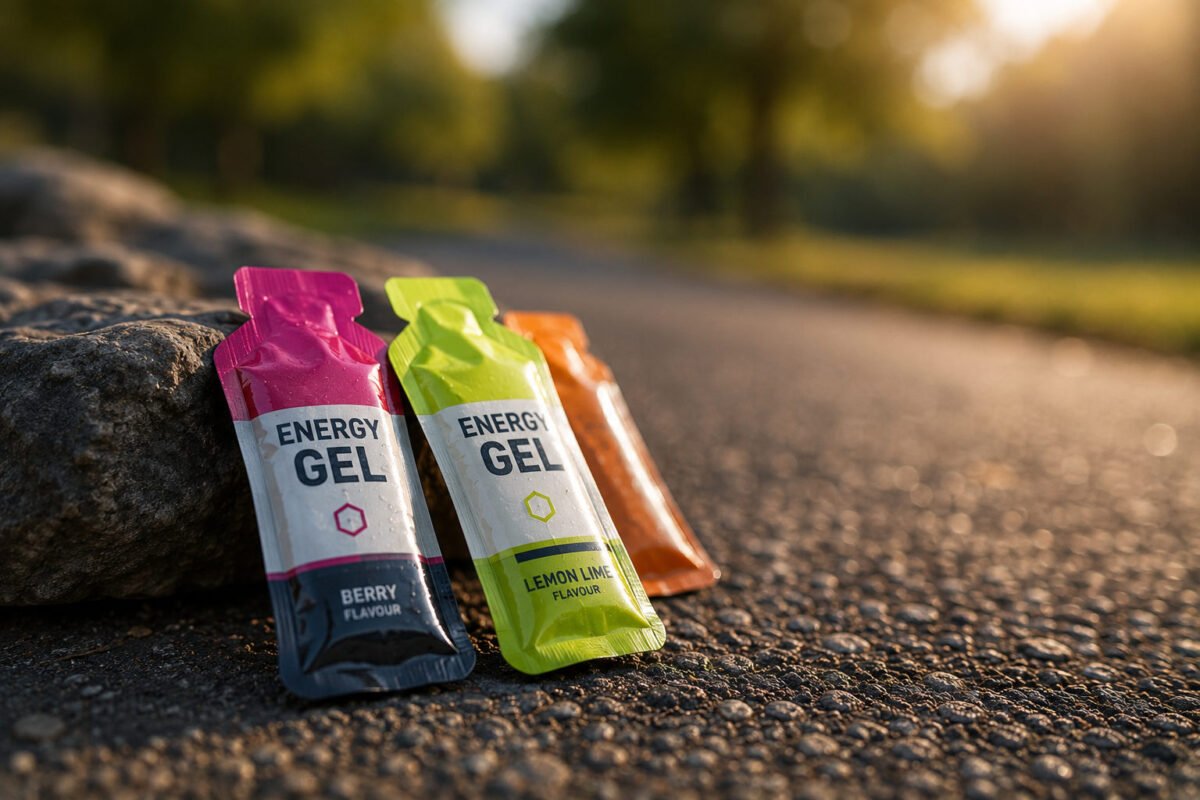
Energy gels have become one of the most recognisable products in endurance running. Every major race expo displays shelves filled with different flavours, caffeine options, and promises of better performance. For someone training for their first race, it’s easy to assume that successful runners simply eat more gels.
The truth is much simpler.
Running gels are not performance enhancers. They are a practical way of replacing carbohydrates during prolonged exercise when your body’s stored energy begins to run low. Used at the right time, they help support endurance. Used unnecessarily, they simply become an expensive snack.
Understanding the difference helps runners make much better decisions.
What Is a Running Gel?
A running gel is a concentrated source of carbohydrates designed to be consumed while exercising.
Because it contains carbohydrates in a compact form, it provides energy without requiring runners to carry large amounts of food. Most gels are also formulated to be easy to swallow and digest while moving, something that is much harder to achieve with ordinary meals.
Some products also include ingredients such as caffeine or electrolytes, although carbohydrates remain their primary purpose.
Think of a gel as portable fuel rather than a special performance product.
Why Do Runners Need Extra Fuel?
Your body stores carbohydrates as glycogen in the muscles and liver.
Those stores provide much of the energy used during running, particularly as intensity increases.
During shorter runs, glycogen stores are usually more than enough.
As the duration increases, however, those reserves gradually decline.
Replacing some carbohydrates during longer exercise helps provide additional fuel and may delay the point at which fatigue becomes more noticeable.
That is where running gels become useful.
When Are Gels Usually Helpful?
Not every run requires mid-run nutrition.
For many runners, easy runs lasting less than an hour can be completed comfortably without eating during the session.
As runs become longer, particularly beyond about ninety minutes, carbohydrate intake during exercise often becomes more beneficial.
Long runs.
Marathons.
Ultramarathons.
Extended trail runs.
These are the situations where gels are commonly used.
The goal is to support performance over long durations, not to fuel every jog around the neighbourhood.
Are Gels Better Than Real Food?
Not necessarily.
Many runners successfully use foods such as bananas, dried fruit, rice cakes, or other easily digested snacks during long events.
Gels offer convenience.
They’re lightweight, easy to carry, and quick to consume without interrupting your run.
For many races, those advantages make them practical.
The best choice is often the one that your stomach tolerates comfortably and that fits your race or training strategy.
Should You Take a Gel Before You Feel Tired?
One of the most common mistakes is waiting until energy has completely disappeared before eating.
By that point, your body is already trying to cope with declining carbohydrate availability.
Many experienced runners follow a planned fueling strategy during longer events instead of relying entirely on how they feel.
The exact timing varies depending on the length and intensity of the run, but consistency is generally more effective than waiting until fatigue becomes overwhelming.
Always Practise During Training
Race day should never be the first time you try a new gel.
Different products contain different carbohydrate combinations, textures, and flavours.
Some runners tolerate one brand comfortably while another causes stomach discomfort.
Long training runs provide the perfect opportunity to experiment.
You can practise timing, hydration, and fueling together under conditions that closely resemble race day.
The more familiar your strategy becomes, the more confident you’ll feel during competition.
Don’t Forget Water
Most gels are designed to be taken with water.
Drinking a few mouthfuls afterwards helps with swallowing and digestion while supporting hydration at the same time.
Ignoring the hydration side of fueling is a common mistake, particularly during warm weather or longer events.
Food and fluids work together.
One supports the other.
Do Beginners Need Running Gels?
Usually not.
Someone beginning a Couch to 5K programme or running for thirty to forty minutes several times each week rarely needs energy gels.
A balanced diet and regular meals generally provide all the energy required for this level of training.
Gels become more relevant as running duration and endurance goals increase.
Understanding when you don’t need them is just as important as knowing when you do.
Fuel the Run, Not the Trend
Running products continue to evolve, and energy gels have become a familiar part of endurance sport.
That doesn’t mean every runner needs to carry them.
The purpose of nutrition is to support the work your body is doing.
If your training doesn’t require additional fuel during exercise, there’s no reason to complicate it.
As your distances grow and your ambitions expand, gels may become another useful tool.
Until then, consistent training, balanced nutrition, and sensible hydration will do far more for your progress than any packet of concentrated carbohydrates.
Like shoes, watches, or hydration packs, running gels are simply equipment.
They aren’t the reason runners succeed.
They help solve a specific problem when that problem exists.
Knowing when to use them, and when not to, is what turns them from a marketing product into a genuinely useful part of endurance running.